What is the pre-event?
DECT World is the annual gathering of the DECT and DECT NR+ ecosystem. This year, the Opener Initiative used the occasion to run a hands-on pre-event on 2 November 2026 in Munich. The aim was not to show slides, but to put the open source NR+ stack in the hands of the participants.
The format was simple. A ten-minute talk opened the session: what Opener is, the technical choices, the state of the code and the roadmap. We summarised it in our Opener status update. Then it was over to three demo tables:
On our table: NR+Gate and NR+Node
We brought about ten gateways and ten sensor nodes, two boards we design and manufacture in Langres, France. Both are supported out of the box by Opener: our Zephyr SDK, codz-sdk, is part of the initiative's opener-samples repository.
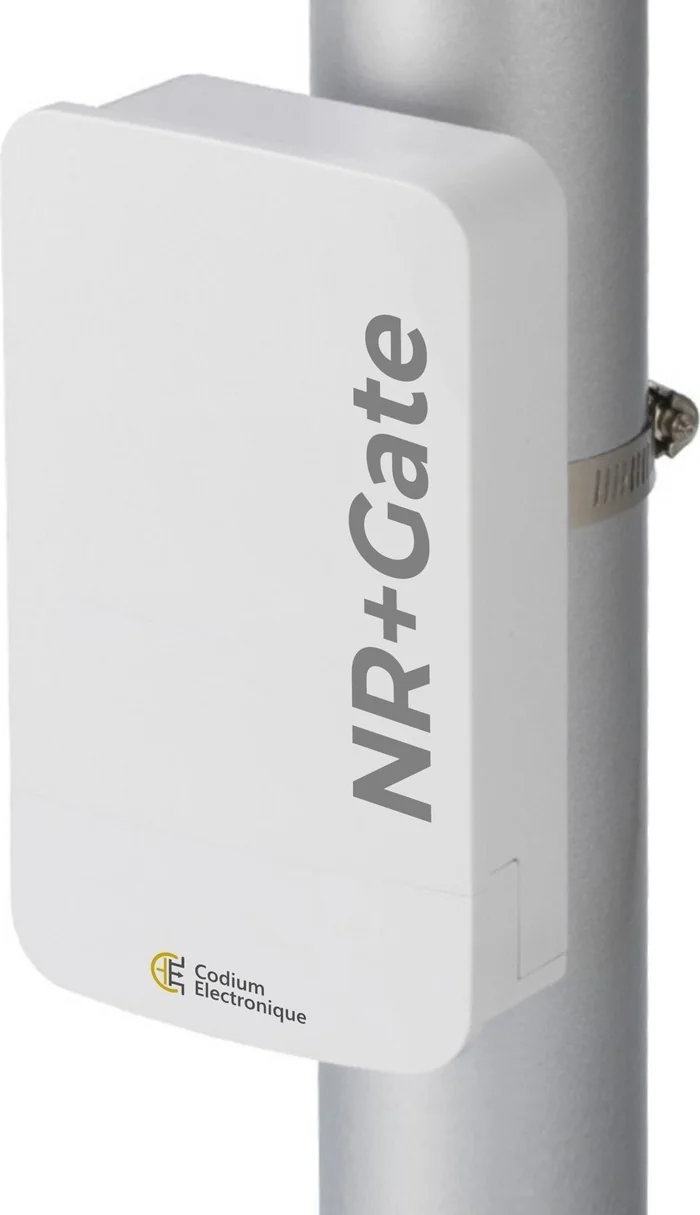
- nRF9151 for NR+, next to a Rockchip RK3566 Linux module
- PoE powered, with Ethernet, Wi-Fi, LTE and GNSS
- IP44 outdoor enclosure
- The Linux side can flash and debug the nRF: a self-contained development box
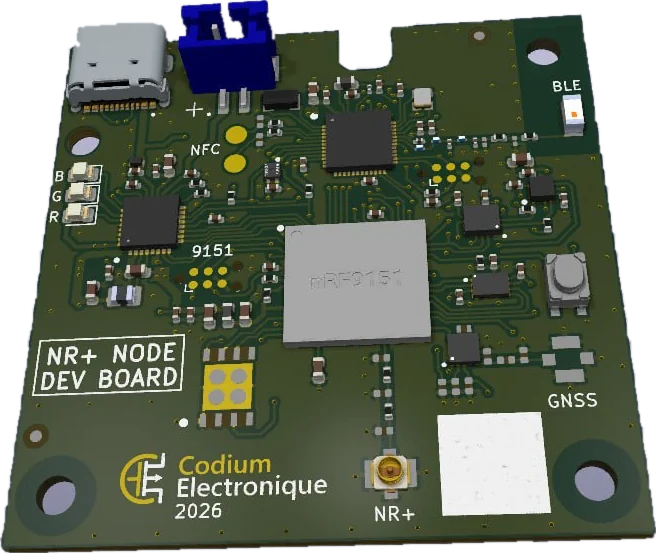
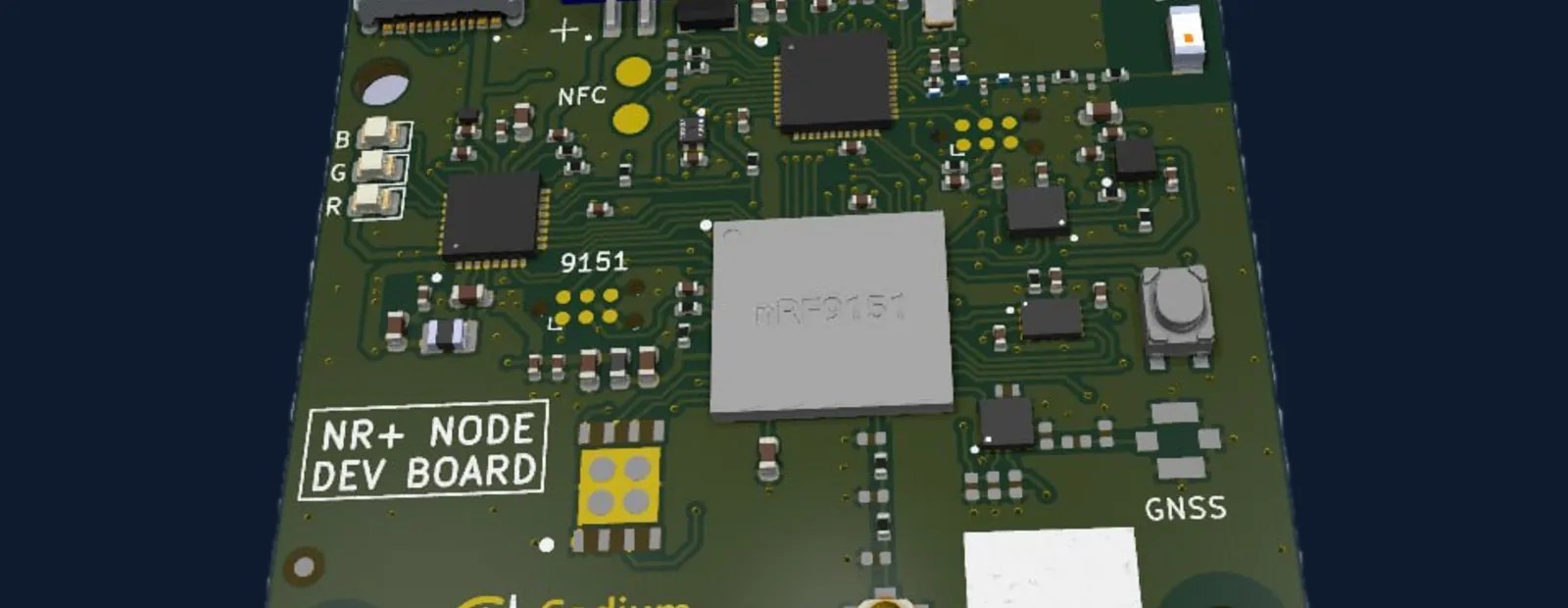
- nRF9151 plus an nRF54L15 for Bluetooth LE
- Temperature and humidity (SHT4x), accelerometer (LSM6DSL), magnetometer (LIS2MDL)
- nPM1300 battery and charger management
- Battery powered
Ready to develop out of the box: the NR+Gate ships with the opener-samples repository set up and our SDK installed. To build on the Opener stack, just connect to the gateway over SSH, through Ethernet or its Wi-Fi access point. The gateway's Linux side can then flash and debug the nRF9151 directly.
Two demos, two gateways
Both demos shared the same base. On each NR+Gate, the nRF9151 runs only the Opener driver and its Spinel interface (the dectnrp-spinel sample). The gateway's Linux side drives the radio over SPI through nrp-hub, a service that owns the link to the radio, accepts one controller at a time and, in parallel, streams everything that crosses the link to the nrp-web web UI. The NR+Nodes run a standalone Opener firmware that transmits their readings.
The sensor node: real-time readings
The NR+Nodes run Opener's dectnrp-driver sample, the ping-pong one, with an option we added to it: before each cycle, the node reads its sensors and sends a 28-byte record instead of the usual "Hello World!". The channel and network ID are set at build time, so on a stand where several NR+ demos share the air, each demo can have its own channel.
| Field | Encoding |
|---|---|
| Header | C0 DE magic, version, validity flags per group of readings |
| Climate | Temperature (0.01 °C) and humidity (0.01 %RH) |
| Accelerometer | x, y, z in mg |
| Magnetometer | x, y, z in mgauss |
| Battery | Voltage, estimated level, charger status and errors, current, VBUS presence |
Demo 1: a sniffer gateway and two nodes on channel 1671
dectnrp-driver sample, readings in the payloadlistening
dectnrp-spinelnrp-hub, nrp-sniffernrp-web: live framesTwo NR+Nodes talk to each other on channel 1671: they synchronise on each other and exchange their sensor records every cycle. The gateway, in sniffer mode, takes no part in the exchange: it keeps reception windows open on the channel and captures every frame from both nodes, which its web UI displays live.
Meanwhile, nrp-sniffer recorded every frame to a pcap file, with the DECT-NR-TAP link type used by deveritec's sniffer. The file can be analysed afterwards: Wireshark (4.7.4 or later) decodes its physical header and MAC PDU.
Demo 2: a gateway driven over TCP from a Linux PC
nrp-pingnrp-hub, nrp-webdectnrp-spineldectnrp-driverHere, the gateway's radio is not driven locally. nrp-hub exposes its control interface over TCP, and a Linux PC on the table runs nrp-ping, the host-side equivalent of the dectnrp-driver sample. Over the network, it initialises the radio, listens for one period, picks the NR+Node out of the frames it hears, then synchronises with it on channel 1673, transmitting half a period after each of the node's frames. It decodes the sensor records on the fly.
The node and the gateway do not need to be configured for each other: they only have to share the channel and the network ID. And the NR+ radio becomes a device you can drive from any machine on the network, not just from the gateway itself.
nrp-web: each gateway shows its frames
In both demos, each gateway served its own nrp-web UI. It is a read-only web view: the frames the radio received, the Spinel exchanges paired by transaction ID, the hub's state and counters, and the option to record a pcap capture from the browser. It never sends anything to the radio, and runs while nrp-sniffer or nrp-ping drives it. In demo mode, it is open to the local network without a token, so any visitor can open it from their phone.
Under the hood: the link between the Linux side and the nRF9151 uses the Spinel interface we developed for Opener, over SPI with IRQ and BUSY lines. Its design and tests are covered in a dedicated article.
The other tables
deveritec, the authors of Opener's driver API and ping-pong sample, showed the dectnrPi: an nRF9151 Raspberry Pi expansion board that also runs standalone over USB-C, with a pin-compatible LMS variant in development. Its synchronisation pins make it possible to coordinate several modems. Their Opener sniffer decoded live NR+ traffic in Wireshark.
hophop, the Rust NR+ stack on Ariel OS, showed a channel-by-channel NR+ scanner, as well as CoAP servers and PC clients joining the network of Nordic's dect_shell sample. hophop will be the first implementation to interoperate with Opener.
Key takeaways
Ten months after Opener's kick-off, we could show a real end-to-end IoT use case on product hardware: a battery-powered sensor, an outdoor gateway, and a radio you can watch and drive from Linux, locally or over the network. The MAC is still missing, but the foundations are in place.
Thanks to everyone who came by for their questions and feedback, and to the deveritec and hophop teams for organising the session with us. If you could not make it and would like to see the demos or try Opener on our boards, get in touch.